
How Virtual Staging can kill your listing

Why real-world property presentation matters more than ever
New Zealand's property market has shifted, and with it, the rules of a good listing. National stock hit 33,149 properties in January 2026 — the first time it's topped 33,000 in a January since 2014. Buyers have more homes to choose from than they have in over a decade, and website traffic data shows they're browsing, comparing, and taking their time rather than rushing to make offers. As one industry commentator put it, there's simply "plenty of stock on the market to choose from."
“Abundant choice and cautious buyers”
That combination — abundant choice and cautious buyers — puts pressure on every listing to earn a second look and, more importantly, to earn trust. In a market like this, how a property is presented in real life matters more than ever. And that's exactly where a growing number of sellers are getting it wrong.
The virtual staging trap
Virtual staging has become a popular shortcut. For a fraction of the cost of physical staging, A.I. can digitally furnish an empty room, add a rug, warm up the lighting, even insert a fireplace or a view. On screen, it looks convincing.
The problem shows up the moment a buyer walks through the front door.
“Reality bears little resemblance to listing photos”
Real estate professionals are increasingly reporting the same pattern: buyers arrive at a property and wonder if they're in the right place, because reality bears little resemblance to the listing photos. Furniture that looked proportionate on screen turns out to be wildly out of scale for the actual room. Warm, styled spaces turn out to be empty, echoing, and cold. Features that were digitally added — a fireplace, outdoor lighting, even a view — simply aren't there.
“Buyers resent it"
Buyers don't take this well. Industry reporting on the issue is blunt: "buyers resent it and respond very negatively when they feel they were deceived about what is offered." That reaction doesn't stay contained to one listing, either. It bleeds into how buyers feel about the agent who marketed the property, and about the seller behind it. Trust, once buyers feel misled, is hard to win back — and a buyer who feels deceived on one property will be far more skeptical of the next listing from the same agent, even if it's entirely honest.
“Evidence in a misrepresentation claim”
This risk isn't hypothetical. In the US, a digitally added fireplace photo became evidence in a misrepresentation claim after buyers discovered a $25,000–$30,000 chimney fault that made the fireplace unusable. California has since introduced legislation (AB 723) requiring disclosure whenever listing photos have been AI-altered. Regulatory attention on this is only increasing.
Cheap now, costly later
The appeal of virtual staging is obvious: it's cheap, and it's fast. But it's worth asking what that low upfront cost is actually buying.
“Price reductions to revive interest”
Poor-quality virtual staging — oversized furniture in a small room, mismatched lighting, staging that looks obviously artificial — tends to do the opposite of its job. Buyers sense something is off and begin to question whether the rest of the listing is honest - and move on to the next property. And for buyers who do show up and feel misled, the outcome is worse still: wasted viewings, stalled negotiations, price reductions to revive interest, and a property that lingers on the market. Every extra week on market, and every price cut needed to re-ignite interest, quietly erodes whatever the seller "saved" by skipping real staging in the first place.
Put simply: cheap virtual staging to save money has the opposite effect on the outcome. In a buyer's market where people can afford to walk away and look at the next listing, that's an expensive trade-off.
What real staging actually delivers
Physical staging solves the scale problem at the source, because the furniture is real. A sofa placed in a living room shows its true size against the walls, the windows, and the walkways around it — buyers can see, accurately, whether their own furniture will fit and how the space will actually function day to day. There's no gap between the photo and the walkthrough, because they are the same room.
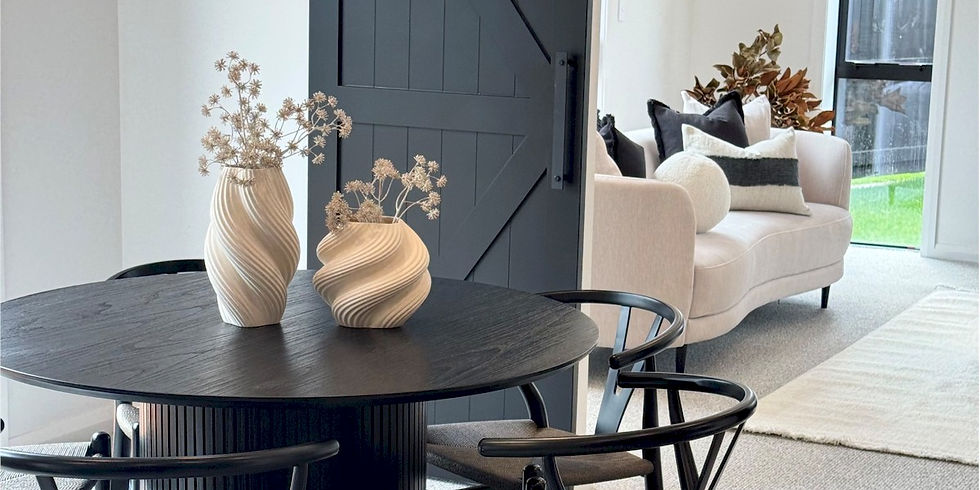
“Real staging positively affects how buyers view a home”
But the real value of good staging goes beyond correct proportions. It's emotional. According to NAR research, 86% of agents say real staging positively affects how buyers view a home, and 83% say it makes it noticeably easier for buyers to picture themselves actually living there. Other industry data puts staged homes selling up to 73% faster than unstaged ones, with real estate agents estimating price uplifts of 1–10% and staging ROI reaching well over 500%.
“Good staging doesn’t just fill a room - it tells a story”
That's the layer virtual staging can't replicate: the felt sense of a home, not just an image of one. Good staging doesn't just fill a room — it tells a story buyers can see themselves inside of, using real light, real texture, and real furniture they can walk around and sit in.
The bottom line
In a market where buyers have the luxury of choice and the caution to use it, the gap between a listing's photos and its reality has never been more costly. Presentation that's honest, accurate, and genuinely inviting doesn't just avoid the pitfalls of misleading marketing — it's what actually gets a property remembered, trusted, and sold.
If you're preparing a property to list, talk to the Beautiful Living team. We'll style your property with real furniture, to the right scale, for the right market, to get the emotional pull that gets buyers to picture themselves at home — before they've even stepped through the door.
Sources:
Property market takes a cautious canter into 2026 — realestate.co.nz
NAR Report Reveals Home Staging Boosts Sale Prices and Reduces Time on Market
When listings lie: AI staging pushes real estate into an ethics gray zone — HousingWire
Bad Virtual Staging: Top Virtual Staging Mistakes to Avoid — Styldod


Comments